Hsu-Pin Lee
“Tayouan – Homeland of foreigners”grand opening at Kunstforum Wien, Vienna, showcases both the natural and cultural landscapes of Taiwan
Artist: Hsu-Pin Lee
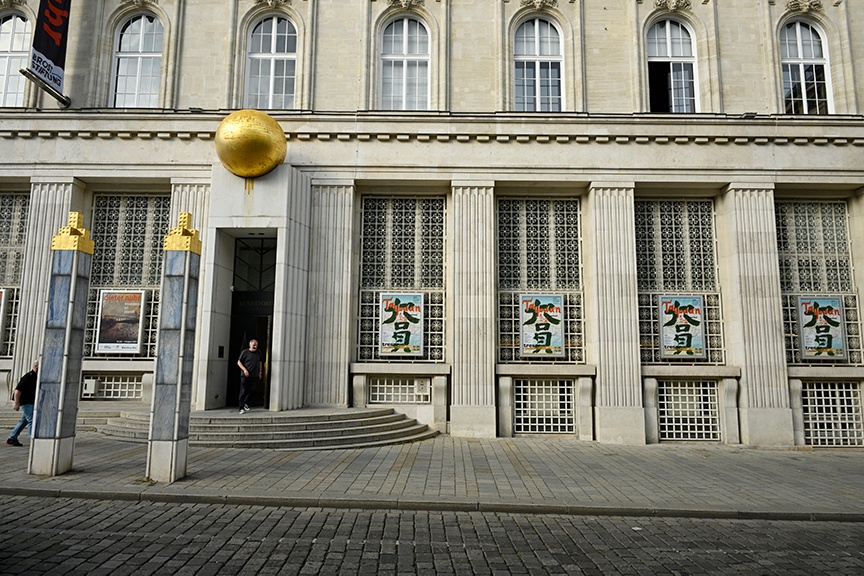
Prompted by the socio-political climate around the presidential elections of January 2024 in Taiwan the exhibition “Tayouan – Homeland of Foreginers” aims to highlight the country’s practice of humanistic values such as democracy, freedom and equal rights.Taiwan is located at a compressive tectonic boundary between the Eurasian Plate and the Philippine Sea Plate and was formed some 4 to 5 million years ago into an island of metamorphic mountain ranges. The name “Tayouan” was first used on a map published by Dutch monk Francois Valentjin in 1726: the horizontal map is shown from a sailor’s perspective looking at the island from the sea. “Tayouan” is the name for sandbank in the language of the Siraya indigenous people, who noticed in the 18th century that many foreigners settled in the region, implicitly giving the meaning to Tayouan as the land of foreigners. Over the next three centuries, this place proceeded to become the homeland of foreigners.
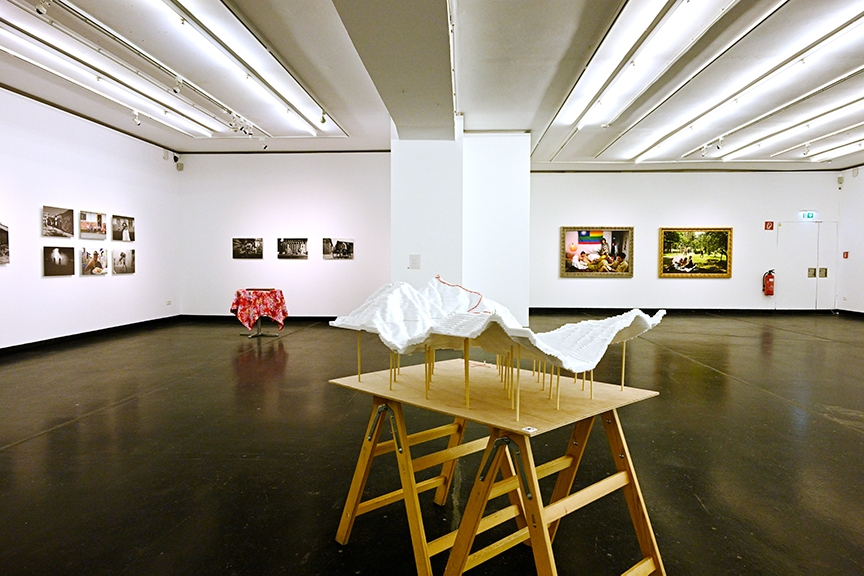 “Island of Mountains” & “Land of Ten Thousand People”The exhibition attempts to present two aspects of Taiwan’s contemporary landscape: on one side the natural landscape of mountains and rivers, on the other side the cultural landscape of people and society. Thus, the approach to Taiwan’s multifaceted landscapes is twofold: “Island of Mountains” displays works by Hsu Cheng-Tang, Lee Hsu-Pin and Wu Sih Chin, “Land of Ten Thousand People” comprises works by Po-I Chen, Robin Wei and Tzeng Yi-Hsin.
“Island of Mountains”
Lying at the meeting point of two tectonic plates, Taiwan has developed one of the largest number and density of high mountains in the world. There are 268 mountains over 3.000m with Jade Mountains (3.952m) being the tallest in East Asia. The Central Mountain Range running North to South the length of the island, forms a natural barrier blocking East-West travel. Very different motivations lay behind the creation of historical trails running through the range: The Qing Dynasty opened up routes such as Kunlun’ao and Batongguan trails as part of their conquering quest, meanwhile the Jinshuiying trail being used for over half millennia by indigenous people. During the era of Japanese rule the Syakaro trail and the Hehuan trail were developed. In modern times, these historical trails have either been reclaimed by nature or have otherwise been transformed into highways. Due to geo-political and strategical reasons the access to the mountains was heavily controlled for a long time, after the lifting of martial law the prohibitions were removed and the range was reintegrated in daily life.
Hsu Cheng-Tangs 16 video works “The Color of Rivers” testify of his ongoing fascination with rivers: he leads us from the shores of the sea, along the stream into the mountains while trying to trace the traditional ways of interaction between streams, people and the environment.
Lee Hsu-Pin’s “The Scenery Enroute” is made up by 16 mounted images and the contour models of mountains. These pieces record his extensive walks in the deep mountains and forests of recent years. His approaches the landscape as a metaphorical fossil, a sort of witness to the spiritual and personal journey people have undertaken there.
Wu Sih Chin’s installation video “Muntjac Imitation” allows us to observe Qiang mountains through the lens of the experience of indigenous hunters, thus becoming the most effective tracking technology in the mountain forest.
“Land of Ten Thousand People”Today’s Taiwan is a country of very mixed ancestry and was shaped by 5 historical foreign rules. Originally Taiwanese aboriginals, who were part of the larger Austronesian language group, had formed kingdom regimes. In the context of the Age of Exploration the Dutch East India Company established the Dutch rule (1624-1662).
1662 the island was taken over by the Ming Dynasty, forming the first Chinese Han rule in the history of Taiwan. Later on, 1683 the Quing dynasty rule started and lasted until 1895 after China was defeated in the first Sino-Japanese war and Taiwan was ceded to Japan. In 1945, after the end of World War II, the Republic of China took over Taiwan on behalf of the Allied. 1949 when the Communist Party of China founded the People’s Republic of China the government of the Kuomintang retreated to Taiwan, the island defending its independent status as a sovereign country ever since.
On the background of Taiwan’s turbulent history, the amalgam of different ethnic groups and communities also created a large diversity of beliefs: aboriginals had ancestor faith and nature worship, Han people believed in Buddhism and Taoism, missionaries from Europe brought Christianity and Catholicism. This broad diversity is deeply engraved in contemporary Taiwanese society – “The Land of Ten Thousand People” and is reflected by the liberal principles governing it.
Po-I Chen’s work “Grand bio-tiann” focuses on the religious cultural activities of Southern Fujian settlements. Working with long exposure techniques, Po-I addresses daily life, meetings and religious celebrations interpreting the local narrative of contemporary life. His works are metaphors for manipulations of time: he holds the scenes still while giving the impression of pushing the fast forward button at the same time. The work “Damiao Cheng” shows Miaocheng, the square in front of the temple, the center of life for the community: printed on large cloth flags of semi-transparent material and mounted at the entrance of the exhibition, this work offering the visitors a symbolic entrance to Taiwan.
Robin Wei’s works originated from hundreds of workshops and visits through the villages of his home region of Zhongpu, Chiayi. A retired lieutenant colonel, Robin Wei has started visiting all remote villages of Chiayi with students of photography capturing portraits of the elders. Part documentary photography, part oral history project Wei’s work is to be shown in a traditional setting of tea-ceremony, replicating the setting for the interactions between photographers and villagers.
Tzeng Yi-Hsin’S “Master Paintings” series challenges the authority of classical paintings through iconographic reconstructions with self-identified non-heterosexual participants. Tzeng attempts to deconstruct the mainstream idea of beauty and authority giving the individual a new power of interpreting images while reconnecting to the own identity. Tzeng removes master paintings from the canonical domain of the white cube to the private space of queer communities. Her grotesque aesthetics becomes a representation of the author’s criticism on heterosexual normativity.
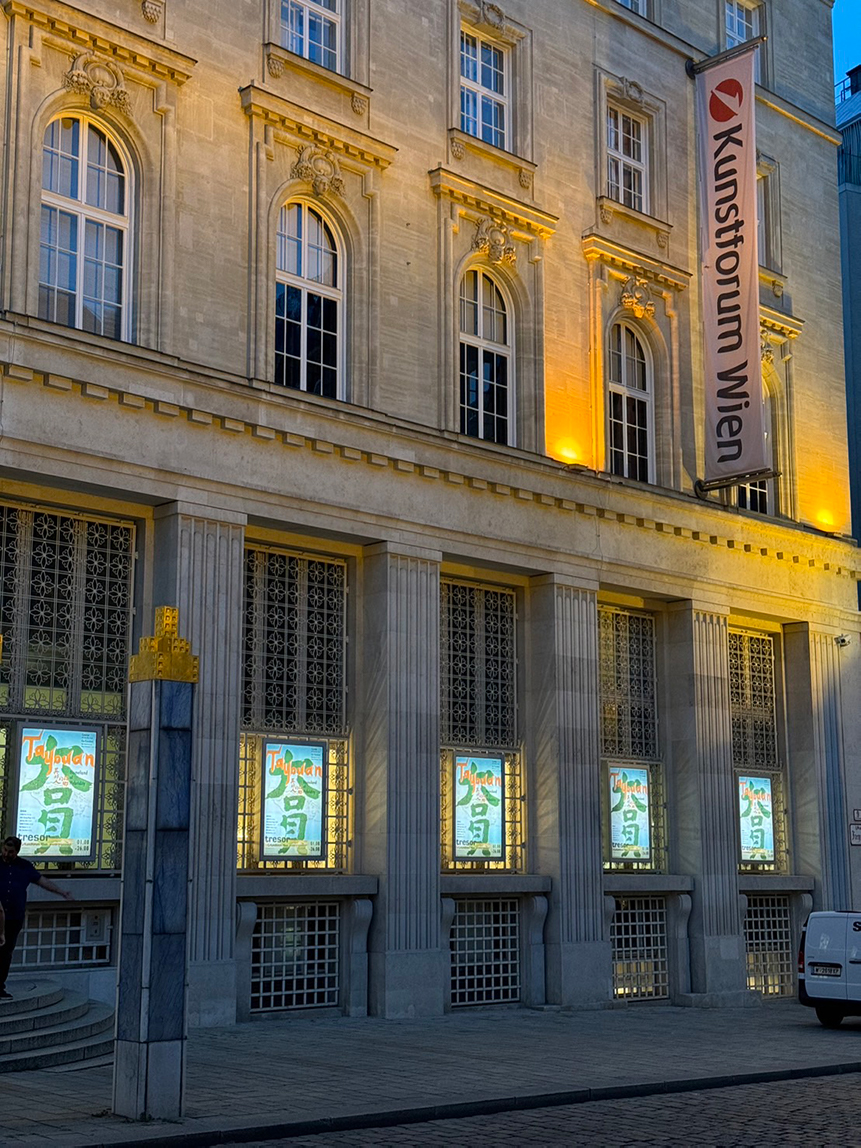 “Tayouan – Homeland of foreigners” attempts a comprehensive approach to both natural and cultural landscapes of a country, that after centuries of constant transformations has morphed into a place of diversity and inclusion.
*Find more information about “Tayouan – Homeland of foreigners” on the official website Kunstforum Wien


